

- Full Size Large Wall Murals
- Mid-size Wall Murals
- Peel & Stick Canvas Murals
- Instant Window Murals
- Wallpaper And Borders
- Door Murals
- Children's Murals
- Hot Deals!
- Tropical Wall Murals
- Disney, Marvel, Nickelodeon & More
- Nature Wall Murals
- QUOTABLES Inspirational messages
- Waterfall Wall Murals
- Peel And Stick Decals
- Peel & Stick Wallpaper & Appliques
- Walls Of The Wild
- Minute Murals
- Pre-pasted Murals
- Sky Box Sports Scenes
- WallPops!
- Murals On Tile
FAQ's
Questions? Email Us: info@themuralstore.com
To Place an Order by Mail Please Print Our Mail In Order Form
Q: What is the difference between pre-pasted, un-pasted, and peel & stick wall murals?
A: All wallpaper murals fall into one of three categories; Pre-pasted, Un-pasted or Peel & Stick.
Un-pasted Wall Murals:The manufacturers of the un-pasted murals place a small packet of powdered paste inside the box at the manufacturing facility. The powdered paste must be mixed with water and brushed onto the back of the mural before installing. The un-pasted murals arrive to you in panels. Each panel is approximately 4ft x 3ft. You apply the panels to the wall one at a time to create the mural. Un-pasted wall murals are suitable for wall applications and cannot be applied to glass. All un-pasted murals are printed on wet-strength paper, they can be wiped occasionally with a slightly damp sponge but are not "scrubbable".
Pre-pasted Wall Murals: The pre-pasted murals are actually pre-pasted wallpaper. They arrive to you in 18 inch wide rolls. The height of the particular mural you purchase will determine the length of that roll, but the width is always 18 inches. The paste is already on the back of the mural. To install you simply unroll a panel and dip it into water, let it sit for a few minutes, and then smooth onto the wall. Each panel is numbered so when you put them up in the right order they will create the picture. The pre-pasted wall murals are suitable for wall applications and cannot be applied to glass. The pre-pasted murals are washable with soap and water and removable by simply peeling away from the wall. Un-pasted murals usually require some scraping, but neither pre-pasted or un-pasted murals will harm the surface of the wall.
Peel & Stick Wall Murals (QuickMurals® brand) are applied by Simply peeling off the protective backing and smoothing onto any smooth, flat non-porous surface - indoors or outdoors. No tools or paste are needed to install the "QuickMurals®". They are printed on Self-adhesive canvas that is impossible to tear, wrinkle or crease. Go ahead! Just try! They are repositionable and can be moved from wall to wall hundreds of times. QuickMurals® will not damage your walls and will not leave any sticky residue when removed. "QuickMurals®" can be applied directly onto glass.
Q: Can I put a mural on my wall if it is concrete, cinder block, has a rough stucco or orange-peel texture, or already has paneling on it?
A: Yes - depending on the type of wall, you may have to do one the following:
Hang lining paper: Using a heavy duty adhesive apply Wall Liner to the wall where the mural is to be placed. Sometimes it helps to paste both the wall surface and the back of the lining paper since the lining paper is porous and heavy. Once the lining paper has dried, apply a primer/sealer. If applying Heavy Duty Wall Liner to cinder-block, concrete or wood paneling, it is best to use an un-pasted wall liner and liberally apply a heavy duty adhesive. This will ensure that the wall liner stays on the wall. Other methods include:
Floating the Walls: Use a broad knife to trowel the joint compound over the rough walls in light, even coats. After the wall is at the preferred smoothness, allow to dry. Prime the newly smooth surface with 2 coats of primer/sealer. Or using a heavy duty adhesive, apply a Heavy Duty wall liner to the wall where the mural is to be placed.
Sanding: If the texture is minimal, this process is adequate and time-saving. After sanding, a primer/sealer is applied. This method is the least preferred, however, because of the labor and the dust that covers the entire house. Applying a Heavy Duty wall liner will also cover lightly textured walls.
Wood-paneled walls: Wash thoroughly with a deglossing solution and water, then sand smooth. Fill vertical grooves of paneling with spackle and apply primer. Seal with acrylic or alkyd primer, allow to cure, and hang wall mural. Or using a heavy duty adhesive, apply Heavy Duty wall liner to the wall where the mural is to be placed.
Q: I found a mural that I like but it is too big for my wall. Can your murals be trimmed down to fit my wall exactly?
A: Trimming a mural to fit your wall exactly is quite common and necessary in some cases. There are a few murals where trimming more than a few inches will ruin the scene though. Examples; "Soft Breeze" and "El Paradiso". Trim away enough of the mural so that you can easily work with it and then when it is on the wall and completely dried, do a final trimming with a razor knife.
Wallpaper Tips & Tricks
Q: What are "run numbers" or "Lot Numbers" and why are they important?
A: A pattern number and dye-lot or "run number" is printed on each roll. A pattern number identifies a particular design and color way of a pattern. The dye-lot number represents a particular group of rolls that are printed on the same print run. Different dye-lot numbers could signal variables such as a possible tonal change of color, a change in the vinyl coating or a change in the embossing process. Because of this, it is very important to check each individual roll in your wallpaper job to ensure uniformity in color and pattern. It is also important to record pattern numbers and dye-lot or run numbers in case additional rolls are needed to complete a project.
Common Wallpaper Characteristics
- Scrubbable means that the wallpaper can withstand scrubbing with a brush and a prescribed detergent solution. (An attribute that would be useful for wallpaper used in a kitchen, bath or laundry room, for example.) Washable means that the wallpaper can withstand occasional sponging with a prescribed detergent solution. (Great for living rooms, dining rooms, bedrooms.
- Stain Resistance is the ability to show no appreciable change after the removal of different types of stains such as grease, butter, coffee, etc. (Ideal for kitchens and baths.)
Abrasion Resistance is the ability to withstand rubbing, scraping or scrubbing. (A good attribute for wallpaper in a foyer or hallway. - Colorfastness is the ability to resist change or loss of color caused by exposure to light. (Most of today's wallpapers easily provide this attribute.
- Peelable means that the decorative surface and ground may be drypeeled from the wall, leaving a continuous layer of the substrate on the wall. This remaining substrate can be used as a liner for hanging new wallpaper. Peelable paper is great if you love the look of wallpaper and plan on redecorating with it again and again
- Strippable means that the wallpaper can be drystripped from the wall leaving a minimum of paste or adhesive residue and without damage to the wall's surface. This is the type to use if your are renting or leasing, as the paper can be easily removed when you leave. Prepasted means that the substrate of the wallpaper has already been treated with an adhesive that is activated by water.
Q: Why is wallpaper priced as a single roll, but only sold as double rolls?
Wallpaper comes in different lengths and widths and, although usually priced by the single roll, it is packaged as double rolls. Because different manufacturers can produce wallpaper in varying widths, the single roll has been adopted as the lowest common unit of measure. This method has been adopted as the standard for the wallpaper industry, and is priced as a single roll by every wallpaper manufacturer. Each packaged unit of rolled up wallpaper actually consists of 2 single rolls on the same spool and packaged as one large unit.
Example: If you ordered two single rolls, and each one covers 28 sq ft. of wall space. What you would receive is one double roll, covering 56 sq. feet of wall space. You're getting the exact same quantity of wallpaper, but the two single rolls are combined and packaged into one.
Pattern Matches
All wallpapers, except some textures and murals, have a pattern repeat. The repeat is the vertical distance between one point on the pattern to the identical point vertically. This pattern repeat is an integral part of the design. The repeat can range anywhere from an inch -- or even occasionally less -- up to as much as the width of the wallpaper or more.
If the wallpaper to be hung has a pattern, find out what type of pattern match it has. There are three major types of pattern matches:
- Random Match -- In this type of pattern, the pattern matches no matter how adjoining strips are positioned. Stripes are the best examples of this type match. It is generally recommended to reverse every other strip to minimize visual effects such as shading or color variations from edge-to-edge. Note that any random match will produce less waste since there is no repeat distance to take into account.
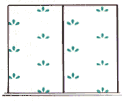
- Straight Across Match -- This match has design elements which match on adjoining strips. Every strip will be the same at the ceiling line.
- Drop Match -- This match has several different types:
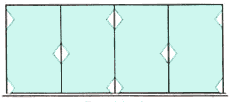
- Half-Drop Match -- Every other strip is the same at the ceiling line and the design elements run diagonally. It takes three strips to repeat the vertical design. If you numbered the strips consecutively, the odd numbered strips (1, 3, 5 and so on) would be identical and the even numbered strips (2, 4, 6, and so on) would match one another. (Note that a drop match is simply a straight match split in half.) Be sure to lightly number (in pencil) on the back of each strip the order in which they are to be hung to avoid confusion.
- Multiple drop Match -- a match that takes four or more strips before the vertical design is repeated. Similar to drop match except it takes more strips to repeat the first strip.
How To Calculate Wallpaper Without a Wallpaper Calculator
Determine your square footage. To do this, measure the height of the walls and add them together. Then measure the width of your walls and ad them together.
Multiply the total height in feet and the total width in feet of your room. This will give you the total square footage.
For each standard door subtract 17 from the square footage. (For any other size door subtract the square footage of the door from the total square feet).
Find the pattern repeat. This can easily be found on the product page of any item on our website.
If the repeat is small meaning the repeat is 12” or less including no repeat, divide the square footage by 25.
If the repeat is large meaning the repeat is 13” or more, divide square footage by 21.
Your total will tell you the amount of single rolls you will need. Remember, wallpaper is sold as a double roll bolt. When ordering 6 single rolls, you will receive 3 double roll bolts of wallpaper.

To Place an Order by Mail Please Print Our Mail In Order Form